Day30 of 90daysofdevopschallenge
Aspiring Devops engineer
Let's get started with Kubernetes.
What is Kubernetes? Write in your own words and why do we call it k8s?
Kubernetes is an open-source container orchestration tool by Google used to manage the container and to do multi-container deployment. All top cloud providers support Kubernetes. We call it k8s as between "k" & "s" it contains 8 letters. So we call Kubernetes as k8s in short form.
What are the benefits of using k8s?
Scalability: Kubernetes makes it easy to scale your applications up or down based on demand.
High Availability: Kubernetes is designed for high availability. It can automatically distribute workloads across multiple nodes to ensure that your applications remain available even if one or more nodes fail.
Container Orchestration: Kubernetes automates the deployment, scaling, and management of containerized applications.
Zero downtime- k8s helps in zero downtime due to its various types of deployment processes. Kubernetes supports rolling updates, allowing you to update your applications without downtime.
Self-Healing: Kubernetes continuously monitors the health of your applications and restarts or reschedules containers if they fail, helping to maintain application availability.
Secrets: Kubernetes offers a secure way to manage and distribute sensitive information, such as passwords and API keys, through Secrets.
Explain the architecture of Kubernetes.
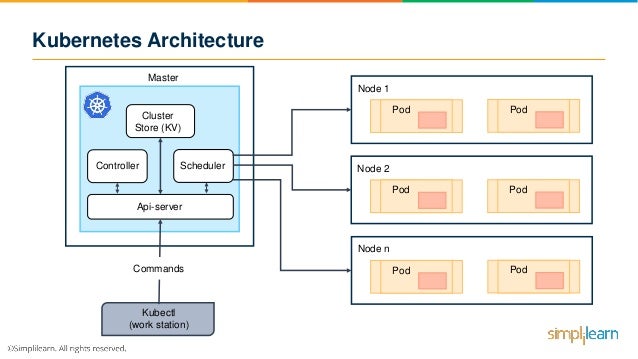
A Kubernetes cluster consists of at least one main (control) plane, and one or more worker machines, called nodes. Both the control planes and node instances can be physical devices, virtual machines, or instances in the cloud.
Masternode consists of 4 components:
Api Server- Whenever we want to send a request to the cluster it should process through api server. The API server will validate the request and send it to the other processes.
Kube Scheduler- whenever a new pod request comes from API server. The scheduler will schedule the pod on any of the nodes. it has the intelligence to where to create the next scheduling pod.
Controller Manager- It always tries to maintain the Actual State of pods = Desired Pods. it detects the state changes. when a pod goes down. The Controller Manager will re-create the pod.
Etcd- It is a kind of database for the cluster. which stores all the cluster information inside it in a key-value pair.
Worker node consists of two components:
Kubelet - An agent that runs on each node in the cluster. It makes sure that containers are running in a Pod.
Kube-proxy- Kube Proxy is a network proxy that runs on each worker node. It maintains network rules on the node and handles routing and load balancing of network traffic to Pods.
What is a Control Plane?
The master is now going to run a set of K8s processes. These processes will ensure the smooth functioning of the cluster. These processes are called the ‘Control Plane.
Write the difference between kubectl and kubelets.
kubectl is a command-line interface used to interact with the Kubernetes API server, while kubelet is a node agent responsible for managing the state of the node and ensuring that containers are running on the node as expected.
Explain the role of the API server.
The API server is the only component that communicates directly with Etcd, all other component calls the API server’s APIs to do anything on Etcd. It also handles authentication, authorization, validation, etc. Whenever we want to send a request to the cluster it should process through API server. The API server will validate the request and send it to the other processes.
So, Today we have started with kubernetes. What is kubernetes and it's architecture. Hope you will find this post worth it. Thank you everyone for reading so far and supporting my efforts.
Kavita Pant